
Aligned Intake Method™ (AIM): Rethinking How Legal Prospects Become Clients
Visibility Is No Longer the Problem—Conversion Is
In today’s legal marketplace, most firms have solved the problem of visibility. Through sustained investment in digital marketing—search, paid media, directories, and content—firms are successfully driving prospective clients to their websites. Yet despite this progress, a more fundamental issue remains largely unaddressed: conversion at the moment of decision.
The majority of legal websites still rely on passive intake mechanisms, contact forms, static calls to action, or basic chat services that request a name and phone number at the outset. These approaches are built on a flawed assumption: that a visitor who arrives on a website is ready to engage. In reality, most prospects are not yet prepared to take that step. They are navigating uncertainty, weighing options, and attempting to understand both their legal situation and the implications of moving forward.
This gap between interest and action is where opportunity is lost.
Why Traditional Intake Falls Short
The Aligned Intake Method (AIM) was developed in response to this exact problem, informed by over two decades of legal marketing and intake experience and refined through real-world application by intake professionals. It is not simply a different intake tool, but a fundamentally different way of thinking about how legal prospects make decisions—and how firms can responsibly and effectively guide that process.
At its core, AIM recognizes that conversion is not an event, but a progression. By the time a prospective client reaches a law firm’s website, they have typically moved through an initial phase of research and education. They have begun to define their problem, explore possible outcomes, and consider whether legal representation is necessary. However, when they arrive at the point of selecting a firm and taking action, many encounter friction: uncertainty about cost, hesitation about commitment, intimidation in initiating contact, or simply a lack of clarity around what happens next.
Traditional intake methods do little to resolve these concerns. In many cases, they amplify them by asking for personal information before trust has been established or before the prospect has fully articulated their needs. The result is predictable: qualified individuals disengage, delay, or continue searching for alternatives that feel more accessible and aligned with their expectations.
AIM: A More Effective Way to Guide Decision-Making
AIM approaches this moment differently by introducing a conversational, structured intake experience that mirrors how individuals naturally move from uncertainty to decision.
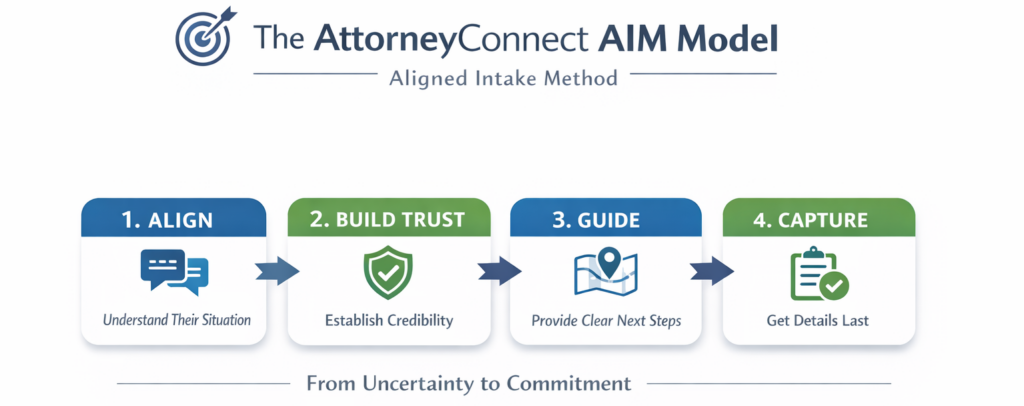
Rather than beginning with contact capture, AIM begins with alignment. Through a guided interaction, the prospect is invited to share basic information about their situation, enough to contextualize their needs without requiring immediate commitment. This initial step serves two purposes. It allows the system to begin qualifying the case, but more importantly, it signals to the prospect that their situation is being understood.
Building Trust Through Understanding and Experience
From there, the process intentionally builds credibility and trust. Instead of asking the prospect to assume the firm’s capability, AIM reinforces it through the interaction itself, demonstrating familiarity with the issue, conveying experience, and creating a sense of competence that is both implicit and reassuring. At this stage, the prospect is no longer evaluating in abstraction; they are beginning to see how this specific firm can help them.
Removing Friction Before It Becomes a Barrier
Equally important is the proactive resolution of friction. Legal consumers often carry unspoken concerns: uncertainty about fees, apprehension about the process, or hesitation rooted in prior experiences or perceived complexity. AIM does not wait for these concerns to become objections. It addresses them directly, within the flow of the conversation, in a manner that is informative but non-threatening. By doing so, it removes the primary barriers that prevent action.
Guiding the Prospect to a Clear Next Step
Only after alignment has been established, credibility has been demonstrated, and hesitation has been reduced does AIM guide the prospect toward a next step. At this point, the path forward is no longer ambiguous. Expectations have been set, the process feels manageable, and the decision to proceed is grounded in clarity rather than pressure.
Contact Information Comes Last—For a Reason
It is at this stage—and not before—that contact information is requested.
This sequencing is critical. By the time a prospect shares their information, they have already expressed intent, met basic qualification criteria, and developed a level of trust in the firm. The interaction has effectively transformed a passive visitor into an engaged, informed, and motivated potential client.
From More Leads to Better Cases
The implications of this approach extend beyond increased conversion rates. AIM also fundamentally improves case quality. Because qualification occurs before contact capture, firms are not simply generating more inquiries—they are generating more relevant, better-aligned opportunities. Intake teams spend less time filtering unqualified leads and more time engaging with prospects who are prepared to move forward.
Perhaps most importantly, AIM reframes the role of the website itself. Rather than serving as a static endpoint in the marketing funnel, the website becomes an active participant in the decision-making process. It does not wait for the prospect to act; it helps them arrive at that decision.
A Shift in How Law Firms Compete
In a competitive legal environment where many firms are investing similar resources into attracting attention, differentiation is no longer defined solely by who generates the most traffic. It is increasingly defined by who can effectively guide that traffic toward meaningful engagement.
The Aligned Intake Method represents a shift toward that future—one in which intake is not transactional, but intentional; not passive, but participatory; and not merely a mechanism for capturing information, but a process for helping individuals move forward with confidence.